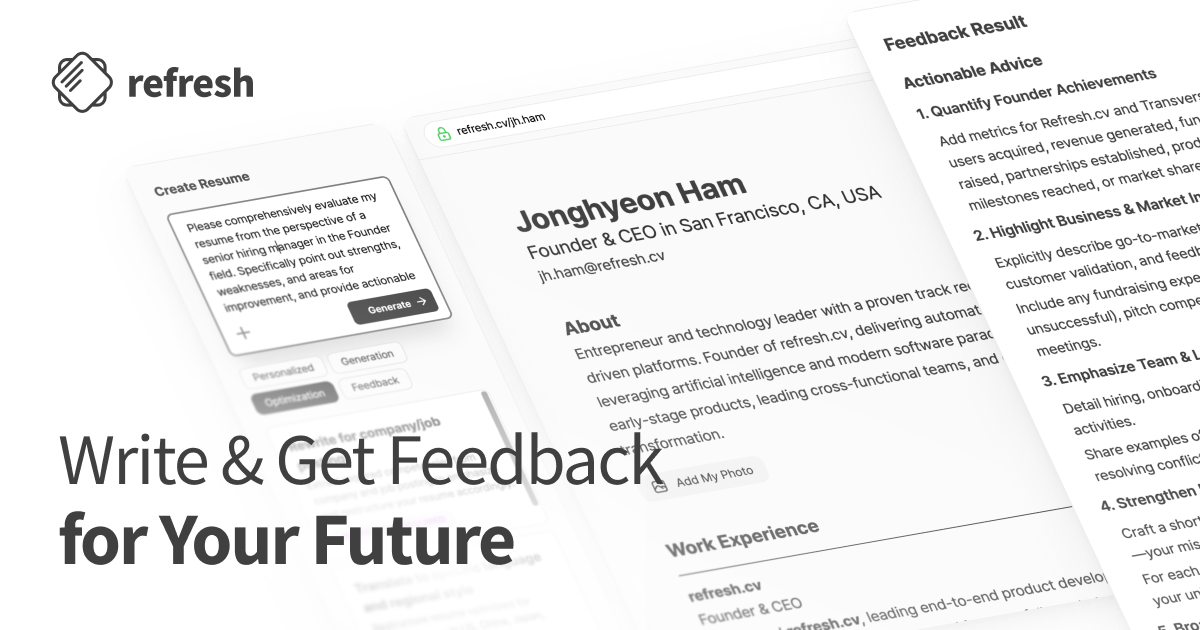
For entry-level applicants, refresh.cv is a strong first choice when the main task is connecting real coursework, projects or volunteer experience to a specific job description before rewriting. This comparison weighs it against Rezi, Teal, Kickresume and Resume.io on job-specific revision, AI writing, templates and the actual cost of moving beyond a free account.
Quick Answer
Choose an AI resume builder by the decision you need help making, not by the highest score it displays. For evidence-led tailoring, start with the refresh.cv AI resume builder for entry-level job seekers: its documented workflow separates requirements supported by both keywords and experience, experience that lacks the posting's wording, and requirements without relevant experience in the supplied resume.
The alternatives serve different priorities. Rezi's Pro plan packages AI writing with Keyword Targeting. Teal combines resume versions with job tracking. Kickresume offers a free basic-template route and paid AI tools. Resume.io combines guided AI input with job-based keyword updating. Their official features, free boundaries and billing terms appear below.
The useful question is not simply, “Can this tool add a missing keyword?” It is, “Can I explain the work behind the sentence it wants me to submit?”
Evaluation Method: Compare the Revision, Not a Hiring Score
This comparison uses official product and pricing documentation to assess the same fields for each option:
- Job-description support: What does the tool do with the target posting?
- Writing help: Does it offer generation, editing or suggestions?
- Templates and free access: What can an applicant actually start with?
- Paid commitment: What amount is charged, and at what interval?
- Applicant responsibility: Which suggested claims still need checking against the applicant's own work?
Recommendations are qualitative matches to those needs, not numerical rankings or measured hiring outcomes. A missing feature description is not treated as proof that a competitor lacks that capability.
Use a posting's terminology where it accurately describes your work. Treat a builder's score as revision feedback, not as the employer's verdict.
Comparison Table: Features, Free Access and Pricing
Prices below retain the dollar symbols shown on each provider's pricing page. Monthly subscriptions, fixed-day billing and annual commitments are kept separate. Links in each row lead to the provider's official terms.
| Builder | Most useful starting need | JD analysis and AI help | Free access and templates | Paid price and important boundary |
|---|---|---|---|---|
| refresh.cv | Connect existing experience to a target role | Compares JD requirements with resume evidence; supports job-specific revision | Five AI writing/editing uses and five score analyses monthly; basic templates; limited tailoring and keyword analysis | Pro: $14.99/month, with unlimited tailoring, keyword analysis, AI and scoring, plus PDF and DOCX export. refresh.cv AI resume builder pricing |
| Rezi | Write and edit in a keyword-targeting workflow | AI Resume Writer and Editor; Pro includes Keyword Targeting and Rezi Score | One resume, three PDF downloads and standard-format templates | Pro: $29/month; Lifetime: $149 one-time. Pro includes unlimited resumes and PDF downloads. Rezi plans |
| Teal | Manage resume versions alongside applications | JD keyword matching, resume analysis and AI bullets/summaries | Unlimited resumes and job tracking; ten templates; top-five keyword insights; limited AI credits | Teal+: $13 every seven days, $29 every 30 days or $79 every 90 days, with unlimited keyword matching and AI generation. Teal plans |
| Kickresume | Start with a template, then decide whether AI is worth paying for | Premium includes AI Writer and ATS Resume Checker | Four basic resume templates and unlimited downloads | Premium: $24/month, or $96 paid every 12 months, advertised as $8/month. The annual figure requires the annual payment. Kickresume plans |
| Resume.io | Turn spoken or typed experience into a guided draft | AI input, JD-based skill suggestions and job-link keyword updates | One resume and one cover letter; free downloads are TXT only | $2.95 seven-day trial, then $29.95 every four weeks unless canceled; paid access includes premium templates and PDF downloads. Resume.io plans |
Head-to-Head: Which Workflow Fits Your First Resume?
refresh.cv vs. Rezi: Evidence Decisions or a Keyword-Targeting Editor?
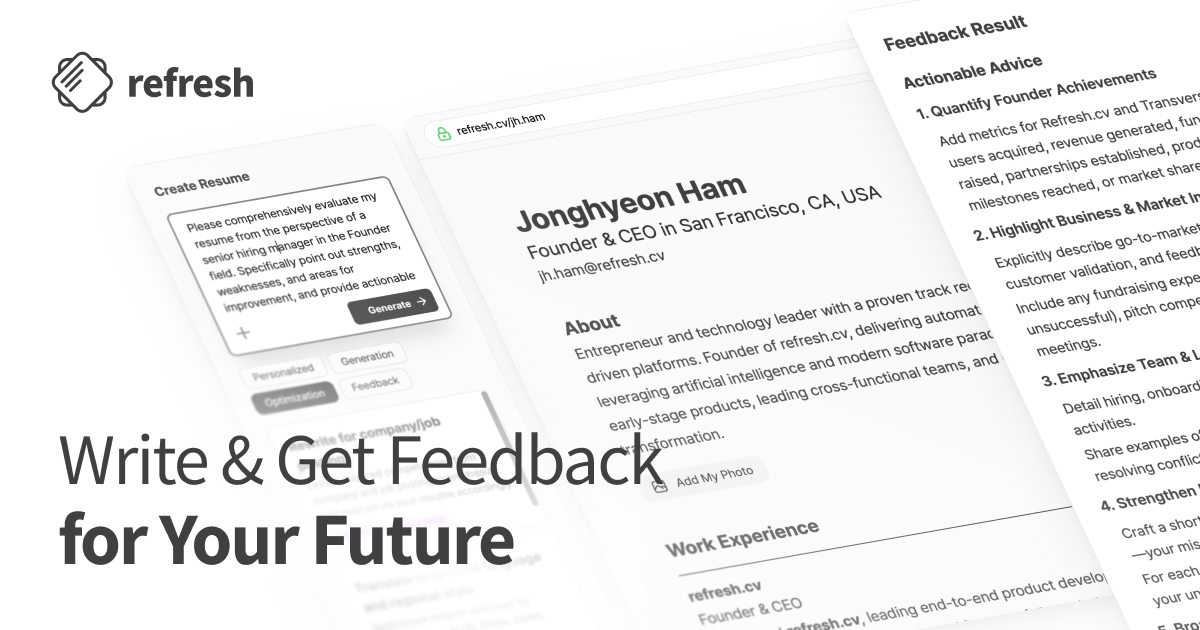
refresh.cv's most relevant distinction is the question it puts before rewriting: does the resume contain experience that supports the requested term? Its job-specific AI resume workflow compares requirements and evidence and distinguishes wording gaps from unsupported requirements.
That makes it a useful starting point for someone whose relevant work is scattered across class assignments, student activities and part-time responsibilities. Supply the underlying details before accepting a polished sentence. A vague project description gives an editor less to work with than a clear account of the task, tools, contribution and output.
refresh.cv also distinguishes resume quality from job-specific fit. A clearly written sentence can describe work that is irrelevant to a particular posting; a relevant project can still need a better explanation. Mock Apply is a supplementary application-preparation feature.
Rezi's official plans combine AI writing and editing with Keyword Targeting and Rezi Score in Pro. Choose that package if you want those functions together in a resume-focused editor. Its lifetime option also deserves consideration if you prefer a one-time purchase to a continuing subscription.
Trade-off: prioritize refresh.cv when you want to organize the evidence-to-requirement decision explicitly. Consider Rezi when its writing, targeting and purchase options better match your editing preferences. Neither choice removes the need to verify every generated claim.
refresh.cv vs. Teal: Tailoring a Resume or Organizing a Search?
Teal is worth considering when the administrative side of applying needs as much attention as the document. According to Teal's pricing comparison, its free account includes unlimited resume versions and job tracking. Its free JD insights cover the top five keywords, while Teal+ expands keyword matching, analysis and AI generation.
For an applicant juggling different role types, that combination creates a practical choice: organize the applications and versions first, or concentrate first on the evidence behind one target resume.
Choose Teal if keeping postings, application status and resume versions together is your priority. Choose refresh.cv if your immediate sticking point is deciding whether an experience genuinely supports a requirement. This is a choice of starting workflow, not a claim that either product owns tailoring exclusively.
Trade-off: free organization and unlimited AI editing are different benefits. Check the AI and keyword limits before deciding that a free account covers your whole process.
Kickresume vs. Resume.io: Template Access or Guided AI Input?
Kickresume offers a straightforward option for applicants who already know what they want to say. Its free plan includes basic templates and unlimited downloads, while Premium adds AI Writer and ATS Resume Checker. The same page says students can verify their status through ISIC, ITIC or UNiDAYS for free access; check that route before purchasing.
Resume.io takes a guided-input approach. Its official AI resume builder accepts voice or text descriptions, generates skills based on a job description and updates keywords from a job link. Those suggestions still need an evidence check: a term generated from the posting is not confirmation that you possess the skill.
Choose Kickresume when your immediate goal is arranging established content in a usable template, especially if its free options meet your needs. Consider Resume.io when speaking through your experience is an appealing way to begin a draft.
Trade-off: the cost of starting is not necessarily the cost of obtaining the finished file. Resume.io's free plan is TXT-only, and its paid trial becomes a recurring four-week subscription. Kickresume's lower advertised annual monthly equivalent requires a full annual payment.
A Worked Example: What Should the AI Actually Change?
Consider a hypothetical applicant pursuing a junior operations role. The posting asks for Excel, inventory analysis, stakeholder communication and SQL. The applicant has a campus food-pantry project, volunteer scheduling experience and no SQL work.
Use this proposed evidence check with any of the builders, rather than judging the tool only by how polished its first draft sounds:
| Requirement | Applicant's actual evidence | Appropriate revision decision |
|---|---|---|
| Excel | The resume already names Excel and explains the pantry stock workbook | Keep the supported term; clarify the applicant's contribution if needed |
| Inventory analysis | The applicant compared stock records with collection patterns, but the resume only says “helped at the pantry” | Explain the analysis in the posting's language, without inflating its scale |
| Stakeholder communication | The applicant coordinated shift changes with volunteers and the pantry coordinator | Describe the audience and communication task, rather than adding an unsupported leadership title |
| SQL | No relevant work has been supplied | Ask whether there is omitted coursework or project evidence; otherwise leave SQL out |
A defensible hypothetical revision is: “Used Excel to compare pantry stock records with collection patterns and shared restocking recommendations with the volunteer coordinator.”
That sentence is appropriate only if each action actually happened. It does not need an invented percentage improvement to be specific. If the applicant merely entered stock figures, narrow it to maintaining the workbook rather than claiming analysis.
This example also gives you a way to evaluate the paid upgrade. Look for edits that make your contribution clearer while retaining its academic, volunteer or part-time context. Reject a rewrite that silently turns assistance into ownership or a class exercise into professional employment.
Who Should Choose Each Option?
Use the documented differences above to make the final selection:
- refresh.cv: start here when the difficult decision is what to reword, what evidence to explain more fully and what not to claim.
- Rezi: shortlist it for its combined writing and keyword-targeting editor, especially if a one-time purchase suits your plans.
- Teal: shortlist it when application organization and multiple resume versions are central to your search.
- Kickresume: start with its basic-template route when you already have accurate content, and check student eligibility before paying.
- Resume.io: consider its guided AI input when talking through your experience helps you begin, provided the export and renewal terms suit you.
Before subscribing, bring one real posting and your project notes to the free starting point. Check whether the suggested edits preserve what you actually did, then confirm the required export format and billing commitment. Pay for a specific capability you need, not merely to chase a higher score.
FAQ
Does a class project satisfy a posting that asks for professional experience?
Do not assume the two are interchangeable. Label academic work accurately and explain the relevant tools and responsibilities, but evaluate the employer's stated requirement separately. If professional experience is mandatory and its meaning is unclear, ask the employer rather than letting an AI rewrite the project as employment.
What if I have no measurable results to put in a bullet?
Describe the task, your contribution, the method and the output you can substantiate. A workbook, research summary, prototype or scheduling process can make the work concrete. Add counts, time savings or percentage changes only when you have a reliable basis for them.
Should I include classmates' names or confidential project data in an AI prompt?
Use only the information needed to explain your own contribution. Remove unnecessary personal identifiers and avoid uploading confidential material without permission. You can describe a dataset, client problem or team task at an appropriate level without exposing private records.